Almost 10,000 public servants walked off the job across New Zealand on Wednesday as frustration over pay, staffing and job security spilled into nationwide industrial action. The government says workers have a right to strike but argues the PSA's campaign has become increasingly political.
eLocal Report: Based on reporting by Jessica Hopkins for RNZ HERE
Thousands of New Zealand public servants have taken nationwide industrial action, with the Public Service Association organising 18 rallies across 16 locations as part of its campaign over public-sector pay, staffing levels and the government's plans to replace thousands of public-sector jobs through greater use of artificial intelligence.
Almost 10,000 workers participated, according to RNZ, with some public servants striking for the first time in decades.
Behind the union banners lies a broader argument about the future of New Zealand's public service: what workers should be paid after several years of rising living costs, how large the state workforce should be, and increasingly, how many of today's jobs will still exist as government agencies adopt AI.
Five Years Without Movement in Some Salary Bands
For workers taking part, the immediate issue remains pay.
PSA national delegate Vaughan Trounson, a patent examiner at the Ministry of Business, Innovation and Employment, told RNZ that some salary bands had not moved for about five years.
Trounson said one colleague had received no pay rise during that period, while household costs continued climbing. He pointed to his own rates bill, saying annual rates on a house he moved into four years ago had risen from about $5000 to between $8000 and $9000.
The result, he said, was that household bills were increasing while real purchasing power had gone backwards.
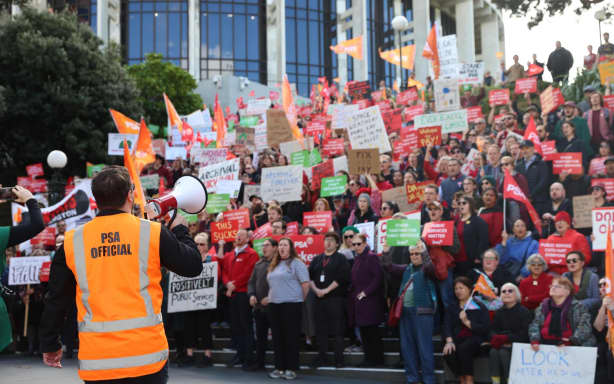
Hundreds gathered in Wellington for Wednesday's public-service strike. RNZ / Zachary Cornelisen
Another Wellington striker, identified by RNZ as Tara, argued that public servants needed to feel valued for the work they performed and stressed their role in providing evidence to government decision-makers.
But the dispute is about more than the percentage increase appearing on a payslip.
Workers described uncertainty about whether they could afford major household expenses, replace vehicles or undertake necessary home repairs while simultaneously facing uncertainty over their employment.
That insecurity is particularly visible in Wellington, which has already absorbed significant public-sector job losses.
Auckland Workers Join Nationwide Action
In Auckland, approximately 200 people gathered at Te Komititanga Square.
MBIE worker Paige Connell Culver told RNZ that the pay offer would leave workers better off next year, but argued that in subsequent years they would effectively be accepting a pay cut.
The original RNZ report also includes video coverage of the Auckland industrial action:
Watch RNZ's video coverage of the strike
PSA national secretary Duane Leo said many workers represented by the union earned between $65,000 and $75,000 annually, with immigration officers — the largest group involved in the industrial action — typically earning around $70,000.
Leo's argument is that members are not seeking extraordinary increases. Instead, the union wants settlements that recognise the accumulated effect of rising living costs.
The union says negotiations have been continuing for months and describes the dispute as approaching a tipping point.
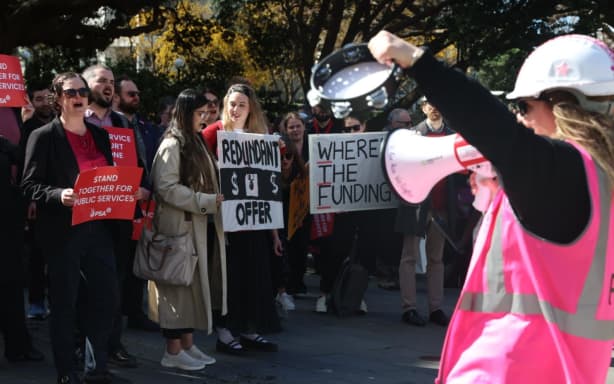
Workers and union delegates told RNZ the rising cost of living had taken a toll on public servants. RNZ / Zachary Cornelisen
Government Says Strike Has Become Political
Public Service Minister Paul Goldsmith takes a markedly different view of the dispute.
In a statement reported by RNZ, Goldsmith acknowledged the PSA's right to strike but said he disagreed with its approach.
He accused the union of conducting an active campaign to “change the government”, arguing that New Zealanders would be inconvenienced as part of what he characterised as a wider political campaign.
Goldsmith also pointed to public-sector pay increases delivered under the previous Labour government, saying substantial increases had already occurred before the current government continued with more modest adjustments.
That introduces an explicitly political dimension into what the PSA presents primarily as an employment and cost-of-living dispute.
The government is effectively arguing that current wage negotiations cannot be separated from the substantial increases previously awarded across the public sector and the wider need to restrain government spending.
The PSA, by contrast, says the issue is what today's wages actually buy.
AI Adds a New Dimension to the Dispute
Perhaps the most consequential element of the strike extends well beyond the current wage round.
The PSA's campaign also opposes government plans to replace thousands of public-sector jobs with AI by 2029, as described by RNZ.
That potentially transforms the dispute from a conventional negotiation over wages and staffing into a much larger debate about what New Zealand's public service will look like within only a few years.
Artificial intelligence can automate administrative processing, analyse large volumes of information and potentially reduce the amount of routine work undertaken manually across government departments.
For taxpayers, successful deployment could mean lower administrative costs and faster public services.
For employees whose existing roles can be automated, the calculation looks very different.
The critical policy question will be whether AI primarily assists public servants to become more productive or is deliberately used to replace them.
That distinction will increasingly matter across both government and the private economy.
A Public Service Under Pressure
Wednesday's industrial action comes after a prolonged period of upheaval within the public sector.
Government agencies have faced pressure to reduce spending and staffing, while workers who remain are simultaneously negotiating wages against a background of elevated household costs.
This creates two competing pressures.
The government is attempting to contain the cost of the state and improve productivity, while public servants argue that wages and staffing must remain sufficient to recruit and retain capable people.
Neither issue can be considered entirely in isolation.
Reducing staff numbers can lower government expenditure, but if workloads remain unchanged it can also increase pressure on remaining employees. Conversely, continuing to increase public-sector wages without corresponding productivity improvements ultimately increases the cost borne by taxpayers.
The argument is therefore not simply whether public servants deserve higher pay.
It is also about how much government New Zealand can afford, how efficiently it operates and what taxpayers should expect in return.
The Cost-of-Living Argument Cuts Both Ways
There is another uncomfortable reality behind the dispute.
Public servants are experiencing many of the same pressures confronting private-sector households: council rates, insurance, food, housing and other essential costs have risen substantially.
But the taxpayers funding public-sector wages are confronting those costs too.
That makes public-sector wage negotiations inherently different from bargaining within a private company.
Higher public-sector salaries must ultimately be financed through taxation, borrowing, reduced spending elsewhere or productivity gains.
The PSA's case is that workers should not continually absorb declining purchasing power.
The government's challenge is determining how to address that without simply transferring the financial pressure from public servants to the wider taxpayer.
What Happens Next?
PSA national secretary Fleur Fitzsimons said union members were insulted by the government's attitude and maintained that the union would rather be negotiating in good faith than taking industrial action.
She said the PSA hoped Wednesday's strike would prompt the government to return to discussions.
RNZ's original report also provides audio coverage through Checkpoint:
Listen: Government workers across the country walk off the job
Whether the nationwide action produces movement at the bargaining table remains uncertain.
What is already clear is that this dispute now reaches considerably further than a conventional argument over annual pay increases.
Nearly 10,000 workers walking off the job simultaneously is a substantial expression of dissatisfaction. At the same time, the government appears determined to continue reshaping the public service, controlling expenditure and accelerating the adoption of technology.
Those objectives are increasingly colliding.
Does This Affect New Zealand?
It affects New Zealand directly because this is ultimately a dispute over how the country wants its government to operate and how much it is prepared to pay for it.
Public servants have a legitimate interest in maintaining their real incomes and employment security. Taxpayers have an equally legitimate interest in ensuring government agencies operate efficiently and that public spending remains sustainable.
AI now adds another layer.
If technology genuinely allows government to deliver the same or better services with fewer administrative staff, ignoring that opportunity would impose unnecessary costs on taxpayers. But replacing experienced employees simply to meet numerical reduction targets could create its own costs through poorer services, lost institutional knowledge and expensive implementation failures.
The real measure of reform should therefore not be simply the number of jobs removed — or preserved.
It should be whether New Zealanders receive better, faster and more cost-effective public services.
Wednesday's strike demonstrates just how difficult that transition may become.
Source: Jessica Hopkins, RNZ, 9 September 2026 — 'More than praise, we need a raise': Thousands of public service workers strike across the country
Independent reporting. Original context. Credited sources.